A daily routine is fundamental to holistic health. Daily actions make up how we live our lives and they have a profound impact on long-term health. Daily routines build structure, creating the container for healthy energy to flow. Ayurveda provides deep insight into just how impactful creating and evolving a daily routine can be.
Dinacharya
Ayurveda refers to daily routine as dinacharya. From Sanskrit, ‘dina’ translates to ‘day’ and ‘charya’ translates to ‘behavior, response or expression.’ It can be understood as the intentions and practices that enable us “to follow the knowledge of the day.”
Dinacharya examines the cycles of nature and bases daily activities around these cycles. We have innate circadian and biological clocks that regulate our bodily functions. Coordinating our activities with these clocks balances the doshas (the primary energies governing the body’s basic functions) and increases Ojas (immunity, strength and vitality).
Dinacharya consists of mindful actions that foster detoxification and promote nourishment for the mind, body and spirit. It is a beautiful opportunity to acknowledge and honor the beauty in this world and to see your importance and connection to it. Importantly, these mindful actions empower individuals to take their health into their own hands and live in the present moment of each day.
Dinacharya is not a one-size-fits-all approach to daily routines. It does not create a checklist of “to-dos”. One’s dinacharya becomes as unique as they are. Dincharya is ultimately an expression of living in rhythm.
Five Sense Therapy
Ayurveda understands that what we take in through each of our five senses has a direct physiological impact on the body. Therefore, morning dinacharya consists of sense cleansing practices to balance the doshas and physiology for the day.
There are specific practices for each sense: washing the eyes, rinsing or oiling the nasal cavity, scraping the tongue, rinsing the mouth, massaging and/or oiling the inner and outer ears, massaging and oiling the entire body and, of course, enjoying a nourishing breakfast. If you aren’t sure which Dinacharya routines are right for you, consult an Ayurvedic practitioner.
If this sounds overwhelming, it really does not have to be – nor is it meant to be. Dinacharya’s very function is to connect and ground. Start small, implement one achievable action at a time. Once that action has become a habit — something that you do consistently without extra thought — then expand your dinacharya toolkit with another action.
Below are some of our favorite morning actions that are beneficial for all:
First, Gratitude
Dinarcharya can begin before you even get out of bed in the morning! Take a moment to acknowledge a new sunrise, a new day and a new opportunity. Take a deep cleansing breath and give thanks for this life. You can invite gratitude in through a mantra, a thought or an intention. If you prefer to journal, you can write a few things down that you are grateful for before bed and you can read these things first thing in the morning.
Tongue Scraping
Once you start, you can’t stop! Tongue scraping takes less than a minute and has a myriad of benefits:
- Removes undigested food, bacteria, natural toxins, and dead skin cells off the surface of the tongue.
- Fights bad breath.
- Increases saliva production which further helps with the digestion process throughout the day.
Tongue scrapers are specifically designed to massage reflexology points on the tongue that are connected with the body. This gently wakes up all the organs preparing them for optimal function throughout the day.
Tongue scraping should be done as soon as you wake up – ideally before taking a drink of water. This is because tongue scraping removes toxins from the tongue that have accumulated overnight. Drinking water can push those toxins back into the digestive system.
Rehydrate
It is necessary to rehydrate in the morning after all the hard work the body has done for you overnight – flushing toxins from the digestive system, blood stream and even the brain!
Ayurveda recommends drinking warm water to foster cellular hydration. Think of the pores on your face. When you wash your face with cold water, the pores contract; but when you wash your face with warm water, your pores open. Our internal cells respond the same way.
When we drink cold water the body has to first disrupt physiological processes that are occurring in other parts of the body to first warm the water up so the cells can receive it. When we drink warm water the cells open are ready to receive the hydration immediately and without extra work!
Meditate
Take a moment to ground into yourself before jumping into daily activities. Utilize the clear energy of the morning to alleviate and build resilience to stress; foster mental clarity and focus; and increase patience, tolerance and positivity.
Find a form of meditation that works best for you. If you aren’t sure where to start, you may wish to try our 11-min Introduction to Meditation, a 10-minute meditation on Daily Presence, or – if you’re short on time – a 5-minute meditation on Living in Rhythm.
Abhyanga
This practice is life-changing, literally! Abhyanga is the practice of massaging warm oil into the body. It can be practiced daily but, if your schedule does not allow for it, try oiling just your feet and hands every day.
The Sanskrit word sneha can be translated as both “oil” and “love.” It is believed that the effects of Sneha Abhyanga (self-oil massage) are similar to those received when one is saturated with love. Like the experience of being loved, Abhyanga can give a deep feeling of stability and warmth.
Self-oil massage reduces stress, lowers blood pressure, improves skin tone and texture, promotes lymphatic drainage, increases alertness, strengthens muscles, lubricates the joints, calms the nerves, promotes restful sleep and enhances vision. When practiced regularly, it can literally change your life!
Nourishment
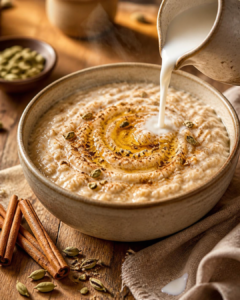
Soothe your nerves, rekindle your digestive fire and fuel your morning with a grounding and nourishing breakfast. **Here is an easy everyday grounding Spiced Porridge Recipe with grain and spice variations.
Dinacharya is the art of balancing time. It is learning how to live in harmony with nature. Living in harmony with nature brings harmony into our lives. What does your path toward living in harmony look like?
Article authored by Chloe Chaput, who is dedicated to her role as a Clinical Ayurvedic Specialist (CAS) to work with women’s health, male and female fertility challenges, parents/caregivers, and children to address a variety of clinical health concerns at the root of their cause. Contact Path Wellbeing today to set up your appointment with Chloe Chaput, CAS.
The information contained within this article is for educational purposes only and should not replace the direct advice of a doctor or other qualified healthcare professional. Always consult a medical or other professional healthcare provider when considering a new health regime.